
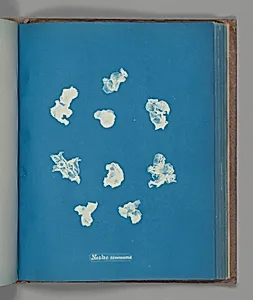
Nostoe commune
ca. 1853
Medium
Cyanotype
Dimensions
Image: 25.3 x 20 cm (9 15/16 x 7 7/8 in.)
Classification
Photographs
Department
Photographs
Museum
Metropolitan Museum of Art, New York, NY
Credit
Gilman Collection, Purchase, The Horace W. Goldsmith Foundation Gift, through Joyce and Robert Menschel, 2005
Accession Number
2005.100.557 (112)
Rights
Public Domain
Art Historical Context
**Nostoe commune**, a captivating cyanotype by Anna Atkins from around 1853, invites visitors to marvel at one of the earliest fusions of science and photography. Atkins, a British botanist and photographer, this delicate blue-toned image measuring 25.3 x 20 cm as a direct contact print of the algae *Nostoc commune*. the cyanotype process—invented just a few years earlier by Sir John Herschel—she coated paper with light-sensitive iron salts, placed the specimen directly on it, and exposed it to sunlight. The result is a ghostly, precise silhouette that captures the plant's intricate textures without a camera, highlighting her innovative approach to scientific illustration. This work holds immense historical significance as part of Atkins' groundbreaking *Photographs of British Algae: Cyanotype Impressions* (1843), the world's first book illustrated entirely with photographs. Produced during photography's infancy, her cyanotypes bridged art and botany, offering unprecedented accuracy for naturalists while their ethereal Prussian blue hues elevated them to artistic masterpieces. Atkins' contributions paved the way for photograms and nature printing, influencing movements like Pictorialism. Housed in The Metropolitan Museum of Art's Gilman Collection, *Nostoe commune* exemplifies how 19th-century experimentation birthed modern photography. Pause here to appreciate its subtle beauty—a testament to a woman's trailblazing role in a male-dominated field.
About the Artist
Anna Atkins · 1799–1871
Anna Atkins (née Children), born on March 16, 1799, in Tonbridge, Kent, England, grew up immersed in the world of science thanks to her father, John George Children, a prominent chemist, zoologist, and curator at the British Museum. After her mother Hester's death shortly after childbirth in 1800, Anna formed a close bond with her father, receiving an exceptional scientific education rare for wome...