
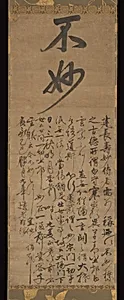
不妙|Not Clever
1425
Medium
Hanging scroll; ink on paper
Dimensions
Image: 36 1/8 in. × 14 in. (91.8 × 35.6 cm) Overall with mounting: 67 1/4 × 14 1/2 in. (170.8 × 36.8 cm)
Classification
Calligraphy
Culture & Period
Japan · Muromachi period (1392–1573)
Department
Asian Art
Museum
Metropolitan Museum of Art, New York, NY
Credit
Mary and Cheney Cowles Collection, Gift of Mary and Cheney Cowles, 2021
Accession Number
2021.398.9
Rights
Public Domain
Art Historical Context
This hanging scroll, created by the Japanese artist Ichidon Shōzui in 1425 during the Muromachi period, exemplifies the refined tradition of ink calligraphy that flourished in Japan at the time. Rendered in bold, expressive brushstrokes on paper, the work’s title “Not Clever” invites contemplation, reflecting the era’s deep engagement with Zen Buddhist ideas that valued simplicity and humility over ostentation. As a hanging scroll, it was designed for vertical display in a tokonoma alcove, allowing viewers to appreciate its composition from a respectful distance during tea ceremonies or quiet reflection. The Muromachi period (1392–1573) marked a golden age for Japanese ink arts, when Zen monasteries became centers of cultural production and calligraphy was esteemed as both a spiritual practice and an aesthetic pursuit. Ichidon Shōzui’s piece belongs to this lineage, where the economy of line and the interplay of ink tones on paper conveyed meaning beyond literal words. Its classification as calligraphy underscores how the arrangement of characters themselves could embody philosophical insight. Today preserved in the Metropolitan Museum of Art’s Asian Art collection through the generous gift of Mary and Cheney Cowles, the scroll offers modern audiences a direct connection to fifteenth-century Japanese artistic sensibilities. Its modest scale—roughly three feet tall—belies the depth of cultural significance carried in every brushstroke.