
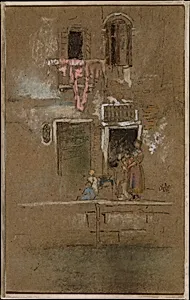
Note in Pink and Brown
ca. 1880
Medium
Charcoal and pastel on dark brown wove paper
Dimensions
11 3/4 x 7 1/4 in. (29.8 x 18.4 cm)
Classification
Drawing
Culture
American
Department
The American Wing
Museum
Metropolitan Museum of Art, New York, NY
Credit
Harris Brisbane Dick Fund, 1917
Accession Number
17.97.5
Rights
Public Domain
Tags
Art Historical Context
James McNeill Whistler, the renowned American artist celebrated for his masterful use of tone and color harmony, created *Note in Pink and Brown* around 1880. This intimate drawing captures a woman framed by a window, evoking a sense of quiet contemplation and subtle elegance. Whistler's Aesthetic movement philosophy—"art for art's sake"—shines through in his focus on atmospheric effects rather than narrative detail, aligning with his famous nocturnes and portraits like *Arrangement in Grey and Black No. 1* (Whistler's Mother). Executed in charcoal and pastel on dark brown wove paper, the work exemplifies Whistler's innovative mixed-media technique. The brown ground provides a rich, tonal base, allowing pastels in soft pinks to delicately model the figure's form and light, while charcoal adds depth and shadow. Measuring just 11¾ x 7¼ inches, this sketch feels like a personal "note," highlighting Whistler's preference for spontaneous, evocative studies over polished finishes. Acquired by The Metropolitan Museum of Art in 1917 through the Harris Brisbane Dick Fund and housed in The American Wing, the piece underscores Whistler's enduring legacy as a bridge between American and European art worlds. Visitors will appreciate its poetic intimacy, a window into the artist's refined vision of beauty in everyday moments.
About the Artist
James McNeill Whistler · 1834–1903
James Abbott McNeill Whistler (1834-1903) was an American-born painter and printmaker who became a leading figure in the Aesthetic Movement and pioneer of Tonalism and Japonisme. He revolutionized art by championing "art for art's sake" and treating paintings as visual equivalents of musical compositions, titling works as "arrangements," "harmonies," and "nocturnes" to emphasize formal qualities o...