
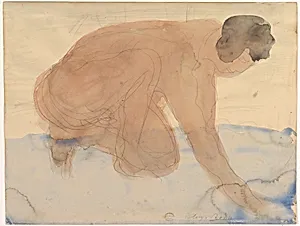
Nude Figure on Hands and Knees (Executioner)
Auguste Rodin, 1900–1910
About this artwork
In the late phase of his illustrious career, French sculptor Auguste Rodin created *Nude Figure on Hands and Knees (Executioner)* around 1900–1910. This intimate drawing, executed in graphite with stumping—a technique Rodin favored to blend tones and create soft, sculptural modeling—and heightened with watercolor, measures 9 3/4 x 12 13/16 inches. Housed in the Metropolitan Museum of Art's Department of Drawings and Prints, it was a generous gift from Thomas F. Ryan in 1913. Rodin, renowned for his revolutionary bronzes like *The Thinker* and *The Gates of Hell*, turned to drawing as a vital exploratory medium, capturing the raw energy and anatomy of the male nude. The dynamic pose on hands and knees evokes tension and movement, embodying his modernist approach to the human form—unidealized, muscular, and psychologically charged. The intriguing title "Executioner" hints at narrative depth, possibly linking to Rodin's fascination with dramatic, historical themes. This work exemplifies Rodin's late-period innovation, where drawings stood as independent artworks rather than mere studies. Its subtle watercolor accents add luminosity and depth, bridging his sculptural prowess with two-dimensional expressiveness, inviting visitors to appreciate the artist's masterful command of light, shadow, and flesh.