
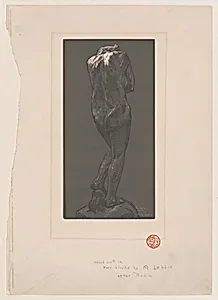
Nude statue, seen from behind
Auguste Rodin|Auguste-Louis Lepère, ca. 1902
About this artwork
In the early 20th century, sculptor Auguste Rodin, renowned for his emotionally charged bronze figures like *The Thinker*, inspired a woodcut titled *Nude Statue, Seen from Behind*. Created around 1902 by printmaker Auguste-Louis Lepère this intimate print captures the back view of one of Rodin's dynamic nude sculptures. Lepère, a master of the woodcut medium, translates the sculptor's tactile forms into stark black-and-gray tones, emphasizing the curve of the spine, the swell of muscles, and the statue's poised contrapposto stance. Woodcuts, carved into wooden blocks and relief-printed, were undergoing a revival in fin-de-siècle France, allowing artists like Lepère to mimic the rough textures of Rodin's clay models with bold, expressive lines. This small-scale work (plate 7 1/16 × 3 5/8 in.) highlights Rodin's revolutionary approach to the nude—celebrating imperfection and movement over classical idealization—while showcasing Lepère's precision in capturing light and shadow on three-dimensional form. Housed in the Metropolitan Museum of Art's Drawings and Prints department, this piece reflects the era's fascination with bridging sculpture and printmaking, inviting viewers to appreciate the human figure's vulnerability and strength from an unconventional rear perspective. A gift from Paul L. Rittenhouse in 1959, it remains a testament to Rodin's enduring influence on modern art.