
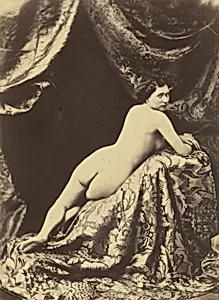
Nude Study
c. 1855
Medium
albumen print
Dimensions
image/sheet: 22.2 × 16.2 cm (8 3/4 × 6 3/8 in.) mount: 37.5 × 29.8 cm (14 3/4 × 11 3/4 in.)
Classification
Photograph
Department
CPH
Museum
National Gallery of Art, Washington, D.C.
Credit
Robert Menschel and the Vital Projects Fund
Accession Number
2020.30.1
Rights
Public Domain
Art Historical Context
**Nude Study**, a captivating albumen print by French photographer Auguste Belloc around 1855, exemplifies the bold experimentation of early photography. Belloc, active in Paris during photography's formative years, specialized in intimate portraits and figure studies, capturing the human form with unprecedented realism. This 22.2 × 16.2 cm image, mounted on a larger 37.5 × 29.8 cm sheet, showcases the nude model's graceful pose, rendered in the soft, luminous tones typical of the albumen process—photography's first widespread commercial method, introduced in 1850. The albumen print's significance lies in its technical innovation: egg whites coated the paper to bind light-sensitive silver salts, yielding sharp details and warm highlights that mimicked fine art engravings. In the 1850s, as photographers like Belloc pushed boundaries, nude studies served dual purposes—artistic training akin to Renaissance drawings and scientific documentation of anatomy. This work reflects France's cultural embrace of the nude in academic art, now democratized through the camera's lens, challenging traditional painting while sparking debates on morality and realism. Housed in the National Gallery of Art's photography department (CPH), thanks to the Robert Menschel and Vital Projects Fund, *Nude Study* invites visitors to ponder photography's role in bridging art and science. Its intimate scale draws you close, revealing the era's pioneering spirit.