
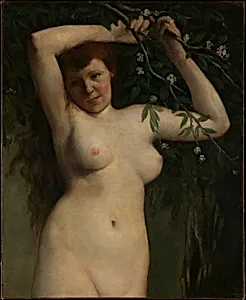
Nude with Flowering Branch
1863
Medium
Oil on canvas
Dimensions
29 1/2 x 24 in. (74.9 x 61 cm)
Classification
Paintings
Department
European Paintings
Museum
Metropolitan Museum of Art, New York, NY
Credit
H. O. Havemeyer Collection, Bequest of Mrs. H. O. Havemeyer, 1929
Accession Number
29.100.60
Rights
Public Domain
Tags
Art Historical Context
Gustave Courbet's *Nude with Flowering* (1863) exemplifies the bold Realism that defined the French artist's revolutionary approach to painting. Created during a time when academic art favored idealized, classical nudes, Courbet rejected romantic embellishments in favor of raw, unvarnished depictions of the human body. This oil on canvas, measuring 29½ x 24 inches, captures a reclining female figure in a lush, natural setting, her skin rendered with earthy tones and palpable texture that emphasize sensuality and vitality over perfection. Courbet's signature technique—thick impasto brushstrokes and dramatic lighting—brings the canvas to life, making the viewer's gaze linger on the interplay of light on flesh and the delicate flowering branch she holds. As part of his provocative series of female nudes, the work challenged 19th-century moral conventions, sparking debate about eroticism in art. Housed in the Metropolitan Museum of Art's European Paintings department from the H.O. Havemeyer Collection, it invites us to appreciate how Realism democratized beauty, grounding the divine in the everyday.
About the Artist
Gustave Courbet · 1819–1877
Jean Désiré Gustave Courbet (1819-1877) was a French painter who revolutionized 19th-century art as the founding figure of the Realism movement. Born in Ornans, a small town in the Doubs region of France, Courbet came from a prosperous farming family with anti-monarchical roots—his maternal grandfather had participated in the French Revolution. This background shaped his lifelong commitment to dep...