
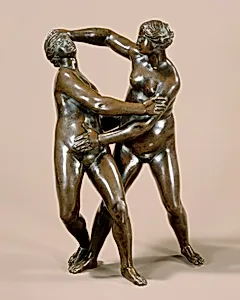
Nude Women Wrestling
mid-17th century
Medium
Bronze, with medium brown natural patina and traces of dark lacquer
Dimensions
Height: 8 1/4 in. (21 cm)
Classification
Sculpture-Bronze
Culture
German
Department
European Sculpture and Decorative Arts
Museum
Metropolitan Museum of Art, New York, NY
Credit
The Jack and Belle Linsky Collection, 1982
Accession Number
1982.60.121
Rights
Public Domain
Tags
Art Historical Context
Behold *Nude Women Wrestling*, a captivating mid-17th-century bronze by German artist Leonhard Kern (158–1666), standing just 8¼ inches tall. Crafted with a rich medium brown natural patina traces of dark lacquer this intimate work exemplifies Kern's mastery of small-scale bronzes, perfect for private collectors' cabinets during the Baroque era. Housed in The Metropolitan Museum of Art's European Sculpture and Decorative department, it comes from The Jack and Belle Linsky Collection1982). Kern, a leading figure in German Baroque sculpture from Schwäbisch Hall, was renowned for his dynamic depictions of the nude human form, blending anatomical precision with playful energy. Here, two female figures grapple in a wrestling pose, capturing motion and tension in a rare fusion of athletic vigor and eroticism—themes that echoed the period's fascination with classical antiquity and the sensuous body. The bronze medium allowed for fine detailing, from rippling muscles to intertwined limbs, highlighting Baroque techniques like lost-wax casting for lifelike expressiveness. This piece offers a window into 17th-century elite tastes, where such "sporting" nudes served as conversation starters, blending art, mythology, and subtle sensuality. Its preserved patina whispers of centuries past, inviting visitors to ponder the bold spirit of Baroque innovation.
About the Artist
Leonhard Kern · 1588–1662
Leonhard Kern (1588–1662), born in Forchtenberg as the fourth son of stonemason Michael Kern the Elder, emerged from a family of masons steeped in architectural sculpture. After attending the Gymnasium in Öhringen, he apprenticed from 1603 to 1609 with his older brother, the sculptor Michael Kern (1580–1649), in Würzburg, mastering stone carving in the family workshop. In 1609, Kern embarked on fo...