
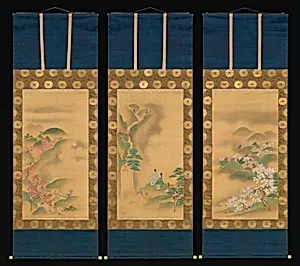
狩野常信筆 滝見業平図|Nunobiki Waterfall, Mount Yoshino, and Tatsuta River
after 1709
Medium
Triptych of hanging scrolls; ink and color on silk
Dimensions
Image (a): 58 9/16 × 31 1/2 in. (148.7 × 80 cm) Overall with mounting (a): 9 ft. 8 9/16 in. × 40 9/16 in. (296 × 103 cm) Overall with knobs (a): 9 ft. 8 9/16 in. × 43 1/2 in. (296 × 110.5 cm) Image (b): 58 9/16 × 31 1/2 in. (148.7 × 80 cm) Overall with mounting (b): 9 ft. 7 15/16 in. × 40 9/16 in. (294.5 × 103 cm) Overall with knobs (b): 9 ft. 7 15/16 in. × 43 9/16 in. (294.5 × 110.7 cm) Image (c): 58 3/4 × 31 1/2 in. (149.3 × 80 cm) Overall with mounting (c): 9 ft. 8 9/16 in. × 40 9/16 in. (296 × 103 cm) Overall with knobs (c): 9 ft. 8 9/16 in. × 43 5/8 in. (296 × 110.8 cm)
Classification
Paintings
Culture & Period
Japan · Edo period (1615–1868)
Department
Asian Art
Museum
Metropolitan Museum of Art, New York, NY
Credit
Mary Griggs Burke Collection, Gift of the Mary and Jackson Burke Foundation, 2015
Accession Number
2015.300.82a–c
Rights
Public Domain
Tags
Art Historical Context
This stunning triptych of hanging scrolls, created by Kano Tsunenobu after 1709 during Japan's Edo period (1615–1868), captures the majestic beauty of nature through scenes of Nunobiki Waterfall, Mount Yoshino, and the Tatsuta River. Painted in ink and color on silk—a luxurious medium favored for its luminous sheen and ability to hold delicate washes—the work unfolds across three large panels, each measuring about 58 by 31 inches in image size. When mounted and displayed together, they form an immersive panoramic vista, evoking the grandeur of famous landscapes revered in Japanese poetry and literature. Kano Tsunenobu, a master of the Kano school—the dominant painting tradition of the Edo era known for its bold compositions, vibrant colors, and decorative flair—likely drew inspiration from classical tales like *The Tales of Ise*. The central figure, the Heian-era poet Ariwara no Narihira (known as "Taki-mi Narihira" for viewing waterfalls), gazes at cascading waters amid rivers, mountains, and blooming flowers. Tags highlight men amid these elemental forces, blending human presence with nature's power. As part of the Metropolitan Museum of Art's Mary Griggs Burke Collection, this piece exemplifies Edo-period artistry, where hanging scrolls served as focal points in elite homes or temples, celebrating seasonal beauty and waka poetry. Its scale invites viewers to lose themselves in the rhythmic flow of water and mist, a timeless reminder of Japan's harmonious reverence for the natural world.
About the Artist
Kano Tsunenobu (Japanese) · 1636 –1713
Japanese, 1636–1713