
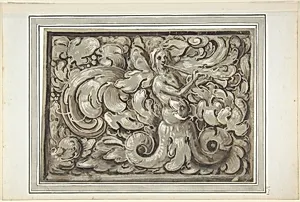
Nymph Playing a Horn (recto); Bracket with a Man's Head (verso)
16th century
Medium
Brush and brown and gray wash, gray-green gouache, heightened with white over black chalk (recto); Brush and brown wash and yellow orange and brown gouache, silhouetted with brush and gray wash; red chalk (verso).
Dimensions
7 5/16 x 10 1/8 in. (18.5 x 25.7 cm)
Classification
Drawings|Ornament & Architecture
Department
Drawings and Prints
Museum
Metropolitan Museum of Art, New York, NY
Credit
The Elisha Whittelsey Collection, The Elisha Whittelsey Fund, 1948
Accession Number
48.148(71)
Rights
Public Domain
Tags
Art Historical Context
This delicate double-sided drawing from 16th-century Germany captures the era’s fascination with classical mythology and architectural ornament. On the recto, a graceful nymph plays a horn amid swirling forms, rendered in brush and brown-gray wash with white highlights over black chalk. The verso reveals a carved bracket supporting a man’s head, executed in vibrant gouache and red chalk, its edges carefully silhouetted as if prepared for transfer or printing. Created by an anonymous artist, the sheet exemplifies the versatile techniques employed by Northern European draftsmen during the Renaissance. Layers of wash and gouache allowed for subtle modeling and depth, while the combination of recto and verso suggests the drawing served both as a study of mythological figures and as a practical design for decorative brackets or friezes. Housed in the Metropolitan Museum’s Department of Drawings and Prints, this small work (just over seven by ten inches) offers a window into the collaborative world of 16th-century design, where such studies informed everything from furniture to architectural details.