
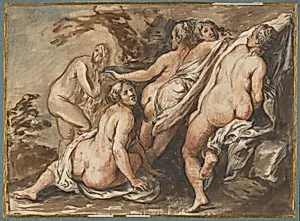
Nymphs Suprised
ca. 1640
Medium
Brush and brown and gray ink, brown and gray washes over red chalk and traces of black chalk, some blue chalk.
Dimensions
7 15/16 x 10 11/16 in. (20.2 x 27.2 cm)
Classification
Drawings
Department
Robert Lehman Collection
Museum
Metropolitan Museum of Art, New York, NY
Credit
Robert Lehman Collection, 1975
Accession Number
1975.1.830
Rights
Public Domain
Tags
Art Historical Context
In the lively tradition of Flemish Baroque art, Jacob Jordaens a moment of mythological surprise in *Nymphs Surprised* (ca. 1640). Jordaens, a prominent painter and contemporary of Rubens Van Dyck, specialized in exuberant scenes of gods, nymphs, and, blending sensuality with dynamic energy. This drawing depicts startled nymphs—graceful female figures often symbolizing nature's purity and allure—frozen in a burst of movement, their nude forms twisting amid foliage. Created during Jordaens' mature career, it reflects the era's fascination with classical antiquity revived through Northern European vigor. The artwork's mixed-media technique showcases Jordaens' masterful draftsmanship: red chalk underdrawings provide warm contours, enhanced by brown and gray inks, washes for depth and shadow, traces of black chalk for accents, and subtle blue chalk highlights. At just 7 15/16 x 10 11/16 inches, this intimate sheet likely served as a preparatory study for a larger painting, revealing the artist's process in building volume and texture through layered washes—a hallmark of 17th-century Flemish drawing. Housed in the Robert Lehman Collection at The Metropolitan Museum of Art since 1975, *Nymphs Surprised* invites visitors to appreciate the tactile immediacy of drawings, bridging studio experimentation and grand canvas. Its playful eroticism and fluid lines embody Baroque exuberance, offering a window into how myths were reimagined for 17th-century audiences.