
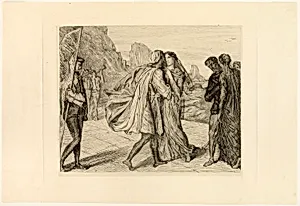
O My Fair Warrior!, plate five from Othello
Medium
Etching, engraving, roulette and drypoint on light gray China paper, laid down on ivory wove paper
Dimensions
Chine: 28.4 × 34.8 cm (11 3/16 × 13 3/4 in.); Plate: 31.5 × 40.2 cm (12 7/16 × 15 7/8 in.); Sheet: 38 × 55.4 cm (15 × 21 13/16 in.)
Classification
etching
Department
Prints and Drawings
Museum
Art Institute of Chicago
Accession Number
40798
Rights
Public Domain
Art Historical Context
In the dramatic world of Shakespeare's *Othello*, Théodore Chassériau a poignant moment with *O My Fair Warrior! plate five from his 1844 series ofings. Created during the height of French Romanticism, this print depicts a charged exchange between Othello and Desdemona, blending literary passion with Chassériau's elegant, Ingres-influenced style. At just 20 years old, the prodigious artist channeled the era's fascination with Shakespearean tragedy, producing these works as affordable yet exquisite illustrations for a growing audience of print enthusiasts. Chassériau masterfully combined etching, engraving, roulette, and drypoint on delicate light gray China paper, then laid down on ivory wove paper for stability and luster. Etching allowed fluid, expressive lines, while drypoint added velvety burrs for emotional depth; roulette provided subtle textures evoking fabric and shadow. These techniques highlight the print's intimacy—dimensions of the Chine appliqué (28.4 × 34.8 cm) make it perfect for close contemplation in the Art Institute of Chicago's Prints and Drawings collection. This rare impression exemplifies 19th-century printmaking's role in democratizing high art, bridging theater and visual culture while showcasing Chassériau's brief but brilliant career before his early death at 37. A testament to Romantic intensity, it invites visitors to ponder love's fragility amid jealousy’s storm.
About the Artist
Théodore Chassériau · 1819–1856
Théodore Chassériau was born on September 20, 1819, in El Limón, Samaná, in the Spanish colony of Santo Domingo — present-day Dominican Republic — to a French father and a Creole mother. The family relocated to Paris in 1820, and the young Chassériau's exceptional talent was evident almost immediately. At just eleven years old, in 1830, he was accepted into the prestigious studio of Jean-Auguste-D...