
Oakland - Shredded Wheat Plant II
1926
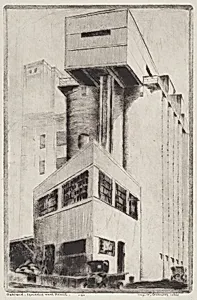
Medium
drypoint
Dimensions
plate: 25.1 × 16.5 cm (9 7/8 × 6 1/2 in.) sheet: 35.6 × 25.2 cm (14 × 9 15/16 in.)
Classification
Department
CG-W
Museum
National Gallery of Art, Washington, D.C.
Credit
Reba and Dave Williams Collection, Gift of Reba and Dave Williams
Accession Number
2008.115.1528
Rights
Public Domain
Art Historical Context
**Oakland - Shredded Plant II** (1926) is a striking drypoint print by Werner Drewes, a German-born artist who bridged European modernism and American Precisionism. Capturing the geometric forms of an industrial Shredded Wheat factory in Oaklandlikely evoking the monumental factories of Niagara Falls—this work reflects Drewes' fascination with America's machine-age architecture during his first visit to the United States that year. At just 25.1 × 16.5 cm on the plate, its intimate scale invites close inspection of the crisp lines and shadowed volumes that define the plant's towering silos and smokestacks. Drypoint, Drewes' chosen medium, involves scratching directly into a copper plate, raising a soft burr that holds ink for richly textured, velvety lines unlike the cleaner etchings of traditional intaglio. This technique lends the print an immediacy and tactile depth, amplifying the Precisionist style's celebration of industrial geometry and modernity. Produced amid the Roaring Twenties' economic boom, it symbolizes the era's awe for technological progress. From the Reba and Dave Williams Collection at the National Gallery of Art, this piece showcases Drewes' pivotal role in introducing European abstraction to American printmaking, offering visitors a window into interwar industry's artistic allure.
About the Artist
Werner Drewes · 1899–1985
Werner Drewes (1899–1985), born in the village of Canig, Germany, to Lutheran pastor Georg Drewes, demonstrated early artistic talent at Saldria Gymnasium, excelling in painting and woodblock printing. Drafted into the German army at eighteen, he served on the Western Front during World War I, finding solace in sketching amid the horrors of war. Postwar, Drewes pursued architecture at the Technisc...