
Ocarina
Unknown Artist
5th–3rd century BCE
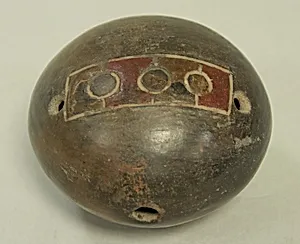
Medium
Ceramic, post-fired paint
Dimensions
H. 2 1/4 × Diam. 2 15/16 in. (5.7 × 7.5 cm)
Classification
Ceramics-Musical Instruments
Culture
Paracas
Department
Arts of Africa, Oceania, and the Americas
Museum
Metropolitan Museum of Art, New York, NY
Credit
Gift of Nathan Cummings, 1963
Accession Number
63.232.2
Rights
Public Domain
Tags
Art Historical Context
This delightful ocarina, crafted by an unknown Paracas artist between the 5th and 3rd centuries BCE, hails from the ancient Andean culture of Peru's south coast. The Paracas people, renowned for their intricate textiles and mummification practices, produced finely made ceramics that reflect a sophisticated society flourishing long before the Inca. Measuring just 2¼ inches high and nearly 3 inches in diameter, this small, portable musical instrument—likely a globular flute or whistle—hints at the rhythms of daily life, rituals, or ceremonies in pre-Columbian Peru. Fashioned from ceramic with post-fired paint, the ocarina showcases skilled pottery techniques where pigments were applied after firing for vibrant, durable color. This method allowed Paracas artisans to achieve bold designs on functional objects, blending utility with artistry. As a rare surviving example of an ancient wind instrument, it offers a window into the auditory world of the Paracas, where music may have accompanied healing rites or communal gatherings. Housed in the Metropolitan Museum of Art's Department of the Arts of Africa, Oceania, and the Americas (gift of Nathan Cummings, 1963), this ocarina invites visitors to imagine the haunting tones echoing across desert landscapes millennia ago—a testament to the enduring creativity of early American cultures.