
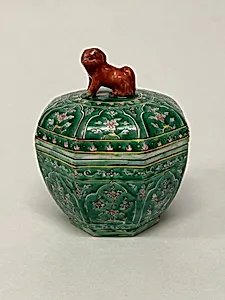
Octagonal jar with cover
Unknown Artist
19th century
Medium
Porcelain painted in overglaze polychrome enamels (Bencharong ware for Thai market )
Dimensions
H. inc. lid 5 in. (12.7 cm); H. w/o lid 2 1/2 in. (6.4 cm); Diam. 4 1/2 in. (11.4 cm); Diam. of base 2 7/8 in. (7.3 cm)
Classification
Ceramics
Culture & Period
China · Qing dynasty (1644–1911)
Department
Asian Art
Museum
Metropolitan Museum of Art, New York, NY
Credit
Avery Fund, 1909
Accession Number
09.70.55a, b
Rights
Public Domain
Tags
Art Historical Context
This delicate octagonal jar with cover, crafted in 19th-century China during Qing dynasty (1644–1911), exemplifies Bencharong ware—porcelain made specifically for the Thai market. Standing just 5 inches tall including the lid, its petite form (base diameter 2⅞ inches) made it ideal for displaying cherished items like incense or jewelry in elite Thai households. The medium, porcelain painted in overglaze polychromeels, allowed artisans to apply vibrant hues of red, green, blue, and gold after the initial glaze firing, creating jewel-like colors that wouldn't fade. Bencharong, meaning "five colors" in Nepali (reflecting its Himalayan design influences via Tibet), burst with intricate motifs of animals, birds, and florals symbolizing prosperity and protection. Exported from Jingdezhen kilns, these jars highlight China's mastery of export porcelain, blending imperial techniques with Southeast Asian tastes during a peak era of global trade. Though the artist remains unknown, the piece's eight-sided shape echoes Thai architectural motifs, bridging cultures. Acquired by the Metropolitan Museum of Art in 1909 through the Avery Fund, this gem in the Asian Art department invites us to marvel at Qing ingenuity and cross-cultural artistry.