
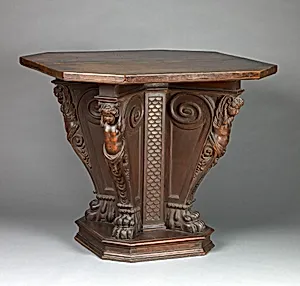
Octagonal table
Unknown Artist
early 20th century
Medium
Walnut, carved.
Dimensions
H. 83.4 cm, W. 99 cm, D. 98 cm
Classification
Woodwork-Furniture
Culture
Italian (?) or American (United States?)
Department
Robert Lehman Collection
Museum
Metropolitan Museum of Art, New York, NY
Credit
Robert Lehman Collection, 1975
Accession Number
1975.1.1952
Rights
Public Domain
Art Historical Context
This elegant octagonal table, crafted from richly grained walnut in the early 20th century exemplifies the fine woodworking traditions of its time. Standing at 83.4 cm high with a 99 cm width and 98 cm depth its symmetrical eight-sided top and carved details invite admiration for the artisan's precision. The unknown maker employed intricate carving techniques on the hardwood, a medium prized for its durability and warm patina, creating a piece that balances functionality with decorative appeal—ideal as a center or occasional table in a grand interior. Its cultural origins remain intriguingly ambiguous, possibly Italian or American, reflecting the transatlantic exchange of design influences during a period when Revival styles blended European craftsmanship with emerging modern tastes. Early 20th-century furniture like this often drew from Renaissance or Arts and Crafts motifs, showcasing skilled handwork amid the rise of industrialization. The octagonal form, less common than rectangular designs, adds a geometric sophistication that highlights the maker's innovative approach. Acquired as part of the Robert Lehman Collection in 1975 and now housed in the Metropolitan Museum of Art's Woodwork-Furniture department, this table offers a window into elite collecting. It underscores the enduring value of anonymous craftsmanship, reminding us that beauty often lies in masterful execution rather than fame.