
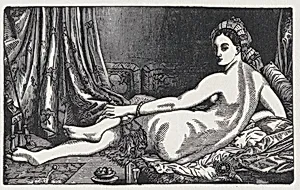
Odalisque viewed from behind, after Ingres
19th century
Medium
Wood engraving
Dimensions
Sheet: 5 11/16 × 7 5/16 in. (14.5 × 18.5 cm) Image: 3 1/16 × 4 5/8 in. (7.8 × 11.7 cm)
Classification
Prints
Department
Drawings and Prints
Museum
Metropolitan Museum of Art, New York, NY
Credit
The Elisha Whittelsey Collection, The Elisha Whittelsey Fund, 1946
Accession Number
46.46.429
Rights
Public Domain
Tags
Art Historical Context
This delicate wood engraving, titled *Odalisque Viewed from, after Ingres*, the sensual curve of a reclining female nude seen from the rear, echoing the masterful compositions of French Neoclassical artist Jean Auguste Dominique Ingres1780–1867). Created by an Mexican artist in the th century, it reproduces Ingres' iconic style—known for its sinuous lines, idealized anatomy, and exotic harem themes inspired by Orientalism. Ingres' odalisques, often depicted in languid poses, blended classical precision with romantic allure, influencing generations of artists. As a wood engraving, this print exemplifies a precise reproductive technique popular in the 19th century, where intricate details were carved into wood blocks for mass production. Measuring just 5 11/16 × 7 5/16 inches, its small scale belies its technical virtuosity, making fine art accessible beyond oil paintings. Housed in the Metropolitan Museum of Art's Drawings and Prints department, part of The Elisha Whittelsey Collection (acquired 1946), it highlights cross-cultural exchange: a Mexican interpretation of European mastery, reflecting global fascination with Ingres amid rising print culture. This work invites viewers to appreciate the nude's timeless allure, a staple of Western art traditions, while underscoring prints' role in democratizing high art.
About the Artist
Jean Auguste Dominique Ingres|Anonymous, Mexican · 1780–1867
Jean-Auguste-Dominique Ingres was born on 29 August 1780 in Montauban, in the Tarn-et-Garonne region of southern France, into a family with deep artistic and musical connections — his father was a painter, sculptor, and musician. He showed exceptional promise from childhood, enrolling at the Académie Royale in Toulouse where he studied under the sculptor Jean-Pierre Vigan, the landscape painter Je...