
Oedipus at Colonus, Cursing his Son Polynices
1777
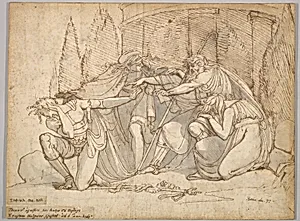
Medium
Pen and brown ink, brush and gray wash, traces of black chalk underdrawing
Dimensions
sheet: 10 3/16 x 13 1/2 in. (25.8 x 34.3 cm)
Classification
Drawings
Department
Drawings and Prints
Museum
Metropolitan Museum of Art, New York, NY
Credit
Purchase, Walter and Leonore Annenberg Acquisitions Endowment Fund and Jean A. Bonna Gift, 2012
Accession Number
2012.241
Rights
Public Domain
Tags
Art Historical Context
Henry Fuseli's *Oedipus at Colonus, Cursing his Son Polynices* (1777) captures a pivotal moment from Sophocles' ancient Greek tragedy, where the blind, exiled Oedipus unleashes a fateful curse on his son Polynices for his treachery against Thebes. Created early in Fuseli's career, this drawing reflects the artist's emerging Romantic sensibility—dramatic, intense, and steeped in classical mythology. Fuseli, a Swiss-born painter who later became a key figure in British Romanticism, drew inspiration from Shakespeare and ancient drama, infusing his works with raw emotion and gothic fervor. Executed in pen and brown ink with brush and gray wash over traces of black chalk underdrawing, the sheet measures 10 3/16 x 13 1/2 inches. This mixed-media technique allows for dynamic contrasts of light and shadow, heightening the scene's tension and foreshadowing Fuseli's mastery of chiaroscuro in oil paintings. Such preparatory drawings were vital in the 18th century for planning grand history paintings, showcasing Fuseli's fluid linework and atmospheric depth. Acquired in 2012 through the Walter and Leonore Annenberg Acquisitions Endowment Fund and a gift from Jean A. Bonna, this work resides in the Metropolitan Museum of Art's Drawings and Prints department. It invites visitors to ponder the timeless clash of fate, family, and hubris in Western literature and art.
About the Artist
Henry Fuseli · 1741–1825
Henry Fuseli (1741-1825), born Johann Heinrich Füssli in Zürich, was a Swiss-British painter whose visionary works exploring dreams, nightmares, and psychological terror made him one of the most original figures of the Romantic movement. His art bridged Neoclassical discipline with Romantic emotionalism, creating images of supernatural intensity that would influence artists from William Blake to t...