
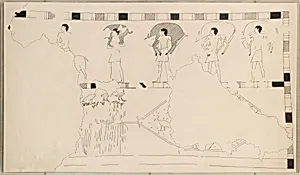
Offering Procession and Netting Fowl, Tomb of Djari
Unknown Artist
ca. 2050–2000 B.C.
Medium
Ink on Paper
Dimensions
h. 41.5 cm (16 5/16 in); w. 71.5 cm (28 1/8 in) - as mounted, scale 1:3, framed: h. 43.2 cm (17 in); w. 73.7 cm (29 in)
Classification
Facsimile, Djari (TT 366), offerings, netting fowl
Period
First Intermediate Period–Middle Kingdom
Department
Egyptian Art
Museum
Metropolitan Museum of Art, New York, NY
Credit
Rogers Fund, 1931
Accession Number
INST.1979.2.12
Rights
Public Domain
Tags
Art Historical Context
Step into ancient Egypt with *Offering Procession and Nettingowl* from the Tomb of Djari, a captivating ink-on-paper reproduction (scale 1:3) of wall scenes dating to ca. 2050–2000 B.C. Created during Dynasty 11, spanning the First Intermediate Period to the early Middle Kingdom, this artwork captures the Theban elite's vision of eternity. Djari, likely a high official, commissioned such tomb decorations to magically sustain his ka (spirit) in the afterlife through vivid depictions of daily rituals and provisioning. The composition bursts with life: a procession of men bearing offerings of food and goods marches forward, while others skillfully net fowl, symbolizing abundance and the Nile Valley's bounty. Rendered in precise ink lines on paper—a modern curatorial copy preserving fragile originals—this piece highlights Egyptian tomb art's hallmark techniques: hierarchical scale, profile views, and symbolic register composition. These conventions ensured harmony between the living world and the divine realm. Displayed in the Metropolitan Museum of Art's Egyptian Art department (acquired via Rogers Fund, 1931), it offers a window into a pivotal era when pharaohs like Mentuhotep II reunified Egypt after centuries of strife. A delightful blend of reverence and realism, it reminds us how art fed both body and soul across millennia.