
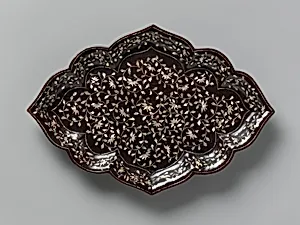
나전 칠 넝쿨 무늬 꽃 모양 반 조선|螺鈿漆唐草文菱花形盤 朝鮮|Ogival tray decorated with floral scroll
Unknown Artist
15th–16th century
Medium
Lacquer inlaid with mother-of-pearl
Dimensions
H. 1 5/8 in. (4.1 cm); W. 12 in. (30.5 cm); L. 17 3/8 in. (44.1 cm);
Classification
Lacquer
Culture & Period
Korea · Joseon dynasty (1392–1910)
Department
Asian Art
Museum
Metropolitan Museum of Art, New York, NY
Credit
Gift of Florence and Herbert Irving, 2015
Accession Number
2015.500.3.9
Rights
Public Domain
Art Historical Context
This exquisite ogival tray, shaped like a blooming diamond with gently pointed edges, hails from Korea's Joseon dynasty (1392–1910), likely crafted in the 15th or 16th century. Measuring about 17 inches long, it served as a practical yet luxurious serving dish for fruits, sweets, or ceremonial offerings. Its surface shimmers with intricate floral scroll patterns—elegant vines and blossoms symbolizing harmony and abundance—inspired by enduring East Asian decorative motifs. The masterpiece showcases *najeon chil*, a revered Korean technique of inlaying thin mother-of-pearl shells into layers of black lacquer. Artisans meticulously cut and polished iridescent shell fragments, embedding them to catch the light and create a luminous, jewel-like effect against the dark ground. This labor-intensive craft, peaking during the Joseon era, reflected Confucian ideals of refined elegance and technical mastery, often adorning elite households or royal gifts. Today, at the Metropolitan Museum of Art (gift of Florence and Herbert Irving, 2015), this tray invites us to appreciate Joseon's fusion of utility and artistry—a testament to artisans' patience and the natural beauty of pearl from distant seas.