
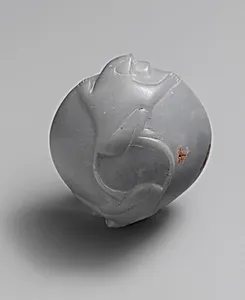
Ointment Bowl with Two Monkeys in Relief
Unknown Artist
ca. 1800–1550 B.C.
Medium
Anhydrite
Dimensions
H. 4.3 cm (1 11/16 in.); W. 9.8cm (3 7/8 in.); Dia. of inner rim 8.5 cm (3 3/8 in.)
Classification
Ointment bowl, baboons
Period
Middle Kingdom–early New Kingdom
Department
Egyptian Art
Museum
Metropolitan Museum of Art, New York, NY
Credit
Theodore M. Davis Collection, Bequest of Theodore M. Davis, 1915
Accession Number
30.8.139
Rights
Public Domain
Tags
Art Historical Context
This delicate ointment bowl, carved from anhydrite—a soft, translucent gypsum variety prized by ancient Egyptian artisans—dates to the Middle Kingdom through early New Kingdom (ca. 1800–1550 B.C.), Dynasties 13–17. Measuring just 4.3 cm high and 9.8 cm wide, with an inner rim diameter of 8.5 cm, it exemplifies the exquisite stoneworking of this transitional era. The bowl's exterior features two lively monkeys in shallow relief, their forms incised with precise, flowing lines that capture the animals' playful postures, adding a touch of whimsy to an everyday vessel. In ancient Egypt, such bowls held precious ointments and cosmetics, essential for personal grooming, rituals, and mummification. Monkeys, often depicted as exotic pets or symbols of protection and vitality, held cultural significance; they evoked the wild energy of nature and were linked to deities like the baboon-headed Thoth, god of wisdom. Crafted during a period of political flux, including Hyksos influence, this piece reflects the enduring Egyptian mastery of carving soft stones into functional art, blending utility with subtle narrative charm. From the Theodore M. Davis Collection (bequest of 1915) at The Metropolitan Museum of Art, it invites us to ponder the intimate daily lives of Egyptians millennia ago.