
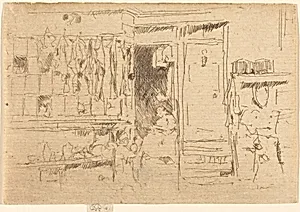
Old-Clothes Shop, No.I
c. 1884/1886
Medium
etching and drypoint in dark brown on laid paper
Dimensions
overall (trimmed to plate): 7 × 10.2 cm (2 3/4 × 4 in.)
Classification
Department
CG-W
Museum
National Gallery of Art, Washington, D.C.
Credit
Rosenwald Collection
Accession Number
1943.3.8574
Rights
Public Domain
Art Historical Context
James McNeill Whistler’s *Old-Clothes Shop,. I* (c. 1884/1886) captures the gritty charm of late Victorian London through the intimate lens of printmaking. This small etching and drypoint measuring just 7 × 10.2 cm, depicts a humble secondhand clothing shop, evoking the bustling street life of the city’s working-class districts. Whistler, a figure in the Aesthetic movement, prioritized mood and harmony over narrative detail, harmonizing subtle tones to create atmospheric depth. The medium—etching and drypoint in dark brown ink on laid paper—showcases Whistler’s mastery as a printmaker. Etching provides precise lines, while drypoint’s direct needle work on the plate produces a soft, velvety burr, adding richness and texture to the shadowed storefront and figures. Trimmed to the plate edges, the work emphasizes its graphic purity, a hallmark of Whistler’s innovative approach to intaglio printing during the 1880s. Housed in the National Gallery of Art’s Rosenwald Collection, this print reflects Whistler’s fascination with urban realism and tonal subtlety, bridging Realism and Impressionism. It invites visitors to appreciate the everyday poetry in overlooked corners of 19th-century life, reminding us of art’s power to elevate the ordinary.
About the Artist
James McNeill Whistler · 1834–1903
James Abbott McNeill Whistler (1834-1903) was an American-born painter and printmaker who became a leading figure in the Aesthetic Movement and pioneer of Tonalism and Japonisme. He revolutionized art by championing "art for art's sake" and treating paintings as visual equivalents of musical compositions, titling works as "arrangements," "harmonies," and "nocturnes" to emphasize formal qualities o...