
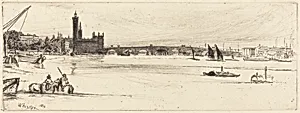
Old Westminster Bridge
Medium
etching and drypoint on laid paper
Dimensions
plate: 7.62 x 20.32 cm (3 x 8 in.) sheet: 10.16 x 22.86 cm (4 x 9 in.)
Classification
Department
CG-W
Museum
National Gallery of Art, Washington, D.C.
Credit
Rosenwald Collection
Accession Number
1943.3.8423
Rights
Public Domain
Art Historical Context
James McNeill Whistler’s *Old Westminster Bridge* (1859) captures a poignant moment in London’s evolving skyline. This intimate etching depicts the historic bridge spanning the Thames, constructed in 1750 and soon to be demolished in 1862 for a wider replacement. Whistler, an American expatriate artist then based in Paris and London, drawn to the city’s atmospheres and industrial grit, blending Realism with emerging Aesthetic principles that prioritized mood over narrative. Rendered in etching and drypoint on paper, the work showcases Whistler’s mastery of printmaking techniques. Etching uses acid to bite precise lines into a copper plate, while drypoint adds velvety burrs from direct needle scratches, creating rich textures and subtle tonal depths in this modest 3 x 8-inch plate. Part of his influential “Thames Set” series, it reflects the 19th-century revival of etching as a fine art, free from reproductive purposes. Housed in the National Gallery of Art’s Rosenwald Collection, this print invites viewers to linger on Whistler’s economical lines, evoking the bridge’s quiet grandeur amid urban change—a timeless reminder of how art preserves what progress erases.
About the Artist
James McNeill Whistler · 1834–1903
James Abbott McNeill Whistler (1834-1903) was an American-born painter and printmaker who became a leading figure in the Aesthetic Movement and pioneer of Tonalism and Japonisme. He revolutionized art by championing "art for art's sake" and treating paintings as visual equivalents of musical compositions, titling works as "arrangements," "harmonies," and "nocturnes" to emphasize formal qualities o...