
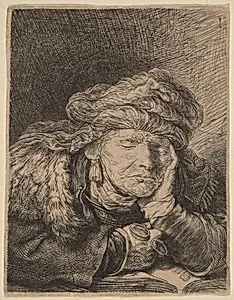
Old Woman Sleeping
c. 1635/1637
Medium
etching
Classification
Department
CG-E
Museum
National Gallery of Art, Washington, D.C.
Credit
Rosenwald Collection
Accession Number
1943.3.7269
Rights
Public Domain
Art Historical Context
In the heart of the Dutch Golden Age Rembrandt van Rijn created *Old Woman Sleeping* around 1635–1637, a delicate etching that captures the quiet intimacy of everyday life. At the time, Rembrandt was establishing himself in Amsterdam as a master printmaker, works that went beyond mere portraits to explore human character and emotion. This piece, housed in the National Gallery of Art'swald Collection, exemplifies his innovative approach during a period when etching emerged as a democratic medium, allowing artists to reproduce and distribute intricate images affordably. Rembrandt's etching technique shines here through his masterful use of line and tone. He combined fine etched lines with subtle drypoint burrs—soft, velvety textures achieved by scratching directly into the plate—to evoke deep shadows and glowing highlights. The old woman's serene face, softly lit against a dark background, reveals his signature chiaroscuro, drawing viewers into her peaceful slumber and the subtle textures of her weathered skin and clothing. This small-scale print (about 5 x 4 inches) transforms a humble subject into a profound study of age and vulnerability. As part of Rembrandt's renowned output of over 300 etchings, *Old Woman Sleeping* highlights his empathy for ordinary people, elevating them to timeless icons. Its cultural resonance lies in bridging fine art with the accessible print world, influencing generations of artists and collectors.
About the Artist
Rembrandt van Rijn · 1606–1669
Rembrandt Harmenszoon van Rijn (1606–1669) stands as one of the greatest visual artists in the history of Western art and the most important Dutch painter of the 17th century. Born in Leiden to a prosperous miller's family, Rembrandt transformed painting through his revolutionary use of light and shadow, his psychological depth in portraiture, and his elevation of etching to a fine art. His approx...