
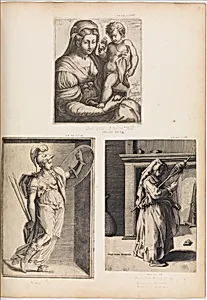
Old Woman Spinning
Medium
Engraving
Classification
Prints
Department
Drawings and Prints
Museum
Metropolitan Museum of Art, New York, NY
Credit
Harris Brisbane Dick Fund, 1927
Accession Number
27.78.2(189)
Rights
Public Domain
Tags
Art Historical Context
"Old Woman Spinning" a captivating engraving created around 1543–44 by Enea Vico after a design by the Mannerist master Parmigianino (Giamo Francesco Maria Mazzola Housed in the Metropolitan Museum of Art's Drawings and Prints, this work—acquired through the Harris Brisbane Dick Fund 1927—blends everyday labor with symbolic elements. The composition features an elderly woman intently spinning wool, surrounded by motifs like soldiers with shields, tender depictions of the Madonna and Child, and other female figures engaged in work, evoking a tapestry of daily life and devotion. Parmigianino, a key figure in the Mannerist movement of the 16th-century Italian Renaissance, was renowned for his elegant, elongated figures and graceful compositions that departed from High Renaissance ideals. Though he died in 1540, his innovative designs lived on through engravers like Vico, a skilled Bolognese printmaker who faithfully reproduced masters' works. Engraving, as a medium, was revolutionary: using a burin to incise intricate lines into copper plates, it allowed for detailed reproductions that could be printed in multiples, making elite art accessible to a broader audience across Europe. This print highlights the cultural interplay of genre scenes and religious iconography during the Renaissance, where humble activities like spinning symbolized patience and virtue. Visitors will appreciate its fine lines and narrative depth, a window into how art bridged the mundane and the divine in the 16th century.
About the Artist
Enea Vico|Parmigianino (Girolamo Francesco Maria Mazzola) · 1523–1567
Enea Vico (1523–1567) was born in Parma and came of age during the final, energetic decades of Italian Renaissance printmaking. By 1541 he had made his way to Rome, where he entered the orbit of the engraver and publisher Tommaso Barlacchi and began his professional career. In Rome, Vico encountered the work of the most celebrated printmakers of the preceding generation—Marcantonio Raimondi, Agost...