
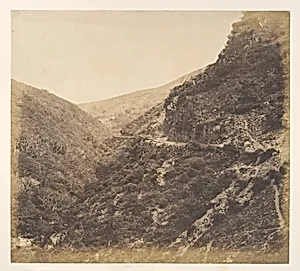
On the Road to Watersmeet, near Lynton, North Devon
Medium
Albumen silver print
Classification
Photographs
Department
Photographs
Museum
Metropolitan Museum of Art, New York, NY
Credit
The Elisha Whittelsey Collection, The Elisha Whittelsey Fund, 1963
Accession Number
63.606.1.29
Rights
Public Domain
Tags
About this artwork
This albumen silver print captures a scenic view along the road to Watersmeet in North Devon, England, documenting the picturesque landscape of the rugged coastline. The photograph presents the natural beauty of the Devon countryside with careful attention to composition and tonal range, showing the rocky terrain and vegetation characteristic of this celebrated region. Arthur Julius Pollock (1835-1890) created this photograph in August 1856, during the formative decades of photography when pract...
Art Historical Context
Step into the rugged beauty of North Devon's countryside with *On the Road to Watersmeet near Lynton* (1856), an albumen silver print by Arthur Julius Pollock (183–1890). This evocative photograph captures a winding road through rocky terrain and lush vegetation, the dramatic landscapes that drew Victorian travelers to this celebrated coastal region. Created in August 1856, it exemplifies the early excitement of photography as both art and documentation. Pollock's image appeared in *The Photographic Album for the 1857*, a publication by The Photographic Club, highlighting his place in Britain's burgeoning photography community. In the 1850s, photographers like him faced immense technical hurdles: preparing light-sensitive chemicals on-site and racing against drying times for outdoor shots. The albumen process—using egg whites to bind silver salts to paper—produced the sharp details and rich tones that made it the gold standard until the 1890s. This work embodies topographical photography's dual role: faithfully recording Britain's scenic wonders for "armchair travelers" while proving the medium's artistic potential. A gem from The Metropolitan Museum of Art's Elisha Whittelsey Collection, it invites us to appreciate how 19th-century innovators like Pollock turned chemistry into captivating visions of nature.