
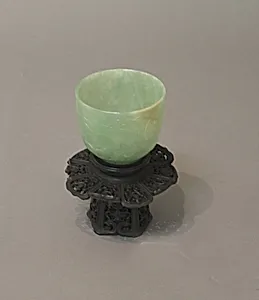
One of pair of cups
Unknown Artist
Medium
Jadeite, emerald-green running to lighter tints, and a few light clouds of creamy white tinged with russet
Dimensions
H. 2 3/8 in. (6 cm); W. 2 13/16 in. (7.1 cm)
Classification
Jade
Culture & Period
China · Ming dynasty (1368–1644)
Department
Asian Art
Museum
Metropolitan Museum of Art, New York, NY
Credit
Gift of Heber R. Bishop, 1902
Accession Number
02.18.359
Rights
Public Domain
Art Historical Context
This delicate jadeite cup, one of a matching pair from China's Ming dynasty (1368–1644), exemplifies the era's mastery of luxury craftsmanship. Measuring a modest 2 3/8 inches high and 2 13/16 inches wide, it features a stunning emerald-green color that fades into lighter tints, interspersed with subtle clouds of creamy white edged in russet. These natural variations highlight the artisan's skill in selecting and shaping premium jadeite to accentuate its inherent beauty. Jade held profound cultural significance in Ming China, revered as "yu," the stone of heaven, symbolizing purity, immortality, and imperial virtue. Small vessels like this were likely crafted for elite rituals, tea ceremonies, or as scholarly treasures, reflecting the dynasty's artistic revival and emphasis on refined elegance. Ming jade carvers employed precise techniques—polishing to a luminous sheen while minimizing waste—to transform raw boulders into functional art, elevating everyday objects to status symbols. Now housed in the Metropolitan Museum of Art's Asian Art Department, thanks to a 1902 gift from Heber R. Bishop, this cup invites visitors to appreciate the timeless allure of Chinese jade, where form, color, and symbolism converge in quiet splendor.