
Oon
Unknown Artist
ca. 500 BCE
Medium
Terracotta
Dimensions
Other: 2 3/16in. (5.5cm)
Classification
Vases
Culture & Period
Greek, Attic · Archaic
Department
Greek and Roman Art
Museum
Metropolitan Museum of Art, New York, NY
Credit
Gift of Albert Gallatin, 1924
Accession Number
24.181.2
Rights
Public Domain
Art Historical Context
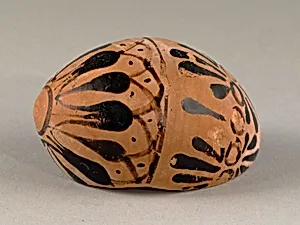
**Oon, ca. 500 BCEThis delicate terracotta *oon*—Greek for "egg"—is a charming miniature vase from Archaic Attic Greece, just 2 3/16 inches (5.5 cm) tall. Crafted around 500 BCE by an unknown artist, it exemplifies the everyday artistry of ancient Athens, where potters produced vessels for practical and ritual uses. Its egg-like form suggests it may have held perfumes, oils, or even served as a grave offering, highlighting the Greeks' fascination with natural shapes in functional objects. In the Archaic period (c. 800–480 BCE), Attic pottery marked a pivotal shift toward more naturalistic human figures and refined techniques, bridging Geometric abstraction and Classical realism. Terracotta, fired clay valued for its durability and workability, was wheel-thrown and often decorated with slip in the iconic black-figure style, though this piece's subtle form speaks to the era's innovative miniaturism. Donated to the Metropolitan Museum of Art in 1924 by Albert Gallatin, it offers a window into the vibrant workshops of ancient Athens. Today, this tiny treasure invites us to marvel at the skill of unnamed artisans, whose work fueled Greece's cultural golden age and influenced art for millennia. A perfect symbol of Archaic ingenuity! (178 words)