
BK-1975-264
1875 - 1900
Medium
wool
Dimensions
185; 350
Rights
Public Domain
About this artwork
Gift of G.W. van Aardenne, Dordrecht
Art Historical Context
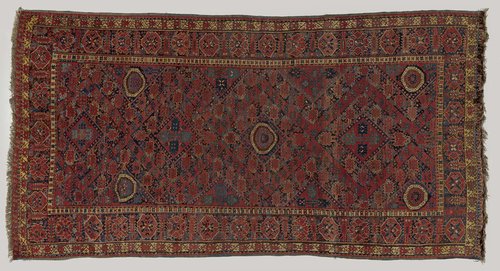
Welcome to our virtual gallery, where we spotlight *BK-1975-*, a striking wool textile crafted by theari people—a Turkmen tribe from Central Asia—between 1875 and 190. Measuring an impressive 350 cm high by 185 cm wide, this large-scale piece was generously donated by G.W. van Ane of Dordrecht, Netherlands, entering our collection in 1975. a tent hanging, door curtain, or storage bagface used in nomadic life, it exemplifies the Ersari's mastery of weaving for both utility and artistry. The Ersari Turkmen, part of the broader Turkic nomadic groups roaming the steppes of present-day Turkmenistan, produced such textiles as essential household items that doubled as symbols of cultural identity. Dating to the late 19th century, this work reflects a period of relative stability before Russian expansion disrupted traditional lifeways, preserving intricate motifs tied to tribal lore, protection, and daily rituals. Hand-knotted in wool—a durable, locally sourced fiber—the piece showcases the Ersari's signature asymmetrical (jijim or Turkoman) knotting technique, ensuring longevity and vibrant pile. These rugs and textiles were woven by women on portable looms, passing down generations of skill. Though patterns aren't detailed here, they typically feature bold geometrics, evoking the vast landscapes and spiritual beliefs of steppe nomads. A testament to enduring craftsmanship!