
Openwork Belt Fitting
Unknown Artist
7th century
Medium
Copper alloy
Dimensions
Overall: 3 1/4 x 1/16 in. (8.3 x 0.2 cm)
Classification
Metalwork-Copper alloy
Culture
Frankish
Department
Medieval Art
Museum
Metropolitan Museum of Art, New York, NY
Credit
Gift of J. Pierpont Morgan, 1917
Accession Number
17.191.251
Rights
Public Domain
Art Historical Context
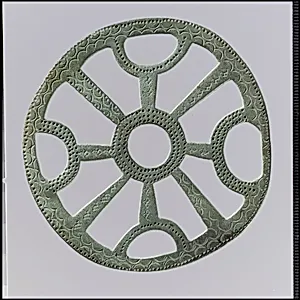
This delicate **Openwork Belt Fitting**, in the 7th century by an unknown Frankish artisan, exemplifies the exquisite metalwork of early medieval Europe. Made from copper alloy and measuring just 3¼ x 1/16 inches (8.3 x 0.2 cm), its slender form features intricate openwork patterns—likely pierced or filed designs that allow light to play through negative spaces. Such fittings adorned belts, securing clothing while serving as subtle displays of wealth and skill. Hailing from the Frankish culture, which dominated much of western Europe during the Merovingian period (ca. 481–751 CE), this piece reflects a time when the Franks blended Germanic traditions with Roman influences. Copper alloy was a practical yet versatile medium, enabling fine detailing that spoke to the era's advancing craftsmanship. Belt fittings like this were everyday essentials for elites, often buried in high-status graves, hinting at their owner's social standing. A generous gift to The Metropolitan Museum of Art from J. Pierpont Morgan in 1917, this artifact invites us to appreciate the artistry in the functional. Though small, it captures the ingenuity of Frankish metalworkers, bridging utility and beauty in the dawn of the Middle Ages.