
Openwork Belt Fitting
Unknown Artist
7th century
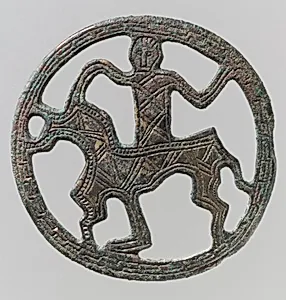
Medium
Copper alloy, "tinned" surface
Dimensions
Overall: 2 11/16 x 1/16 in. (6.8 x 0.2 cm)
Classification
Metalwork-Copper alloy
Culture
Frankish
Department
Medieval Art
Museum
Metropolitan Museum of Art, New York, NY
Credit
Gift of J. Pierpont Morgan, 1917
Accession Number
17.192.164
Rights
Public Domain
Tags
Art Historical Context
This delicate openwork belt fitting, crafted by an unknown Frankish artisan in the 7th century, exemplifies the exquisite metalwork of the Merovingian period early medieval Europe. Measuring just 2 11/16 x 1/16 inches, this copper alloy piece features a tinned surface—a technique where a thin layer of tin was applied to create bright, silvery sheen, making affordable copper mimic the luxury of silver. Openwork design, with intricate cutouts, allowed light to play through the motifs, enhancing its visual appeal on a belt or strap. The fitting likely depicts dynamic scenes of human figures and horses, common motifs in Frankish art symbolizing status, warfare, or daily life among the elite. Such accessories were not mere fasteners but badges of prestige, worn by warriors or nobility during the Frankish kingdoms' expansion across Gaul and beyond. This craftsmanship reflects advanced technical skill, blending functionality with artistry in a time of cultural transition from late antiquity to the Middle Ages. A generous gift from J. Pierpont Morgan in 1917, it now graces the Medieval Art department at The Metropolitan Museum of Art, offering visitors a tangible glimpse into Frankish ingenuity and the vibrant world of 7th-century Europe.