
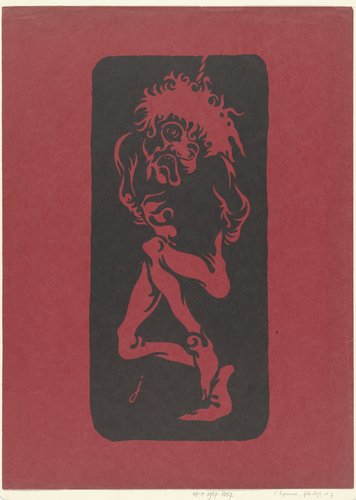
Opgehangen man
Medium
lithography
Dimensions
149; 291; 320; 399
Rights
Public Domain
About this artwork
beeld: hoogte 320 mm x breedte 149 mm
Art Historical Context
**Opgehangen Man (Hanged Man)** *Henri Gustave Jossot, 1895, Lithography, 320 × 149 mm* Henri Gustave Jossot's *Opgehangen Man*, created in 1895, is a striking lithograph capturing a vertical composition in a modest 320 mm by 149 mm format. The Dutch title translates to "Hanged Man," suggesting a dramatic or provocative scene likely rooted in Jossot's signature satirical style. As a prominent French caricaturist of the fin-de-siècle, Jossot was renowned for his bold, grotesque illustrations that critiqued society, religion, and politics, often published in humor magazines like *Le Rire* and *Gil Blas illustré*. Lithography, Jossot's chosen medium, was revolutionary in the late 19th century, allowing artists to produce detailed, reproducible images with crayon-like fluidity directly on stone. This technique democratized art, enabling sharp social commentary to reach wide audiences through posters and periodicals. The work's narrow, upright dimensions evoke broadsheets or journal inserts, amplifying its immediacy during the Belle Époque's vibrant print culture. Though specifics of the imagery remain elusive, *Opgehangen Man* exemplifies Jossot's unflinching gaze on human folly or injustice. Later in life, Jossot renounced his satirical past to embrace Sufi Islam, adding layers to his provocative legacy. A poignant reminder of art's power to provoke thought. (198 words)