
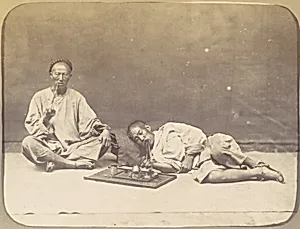
Opium smoker
Medium
Albumen silver print from glass negative
Classification
Photographs
Department
Photographs
Museum
Metropolitan Museum of Art, New York, NY
Credit
Robert O. Dougan Collection, Gift of Warner Communications Inc., 1981
Accession Number
1981.1229.51.2
Rights
Public Domain
Tags
Art Historical Context
In 1867, British photographer William Thomas Saunders captured *Opium Smoker*, an evocative albumen silver print from a glass negative that offers a stark glimpse into mid-19th-century Chinese. Working primarily in Hong Kong and Shanghai, Saunders in documenting everyday life among the Chinese populace, producing intimate portraits and genre scenes popular among Western expatriates and collectors. This photograph, part of the Metropolitan Museum of Art's Robert O. Dougan Collection, exemplifies his focus on "types"—stereotypical representations of local customs and trades. The albumen process, the gold standard for photography from the 1850s to 1890s, yields rich tonal depth and fine detail, with egg-white coatings enhancing highlights and shadows to bring the smoker's contemplative pose vividly to life. Amid the Opium Wars' aftermath (1839–1860), when British trade flooded China with the narcotic, images like this highlighted a pervasive social issue: widespread addiction affecting millions. Saunders' work, often sold as cartes-de-visite, bridged cultural divides, sparking fascination and debate in the West about exoticism and imperialism. Today, *Opium Smoker* serves as a poignant historical document, reminding us of photography's power to preserve vanishing worlds while critiquing colonial encounters. Visitors, note the subtle textures of pipe and attire—testaments to the era's technical artistry.