
Opstanding van Christus
Cherubino Alberti, 1628
About this artwork
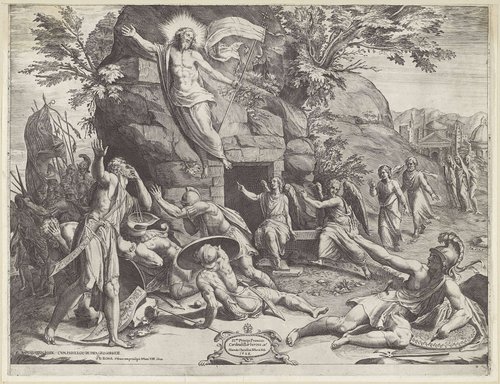
Cherubino Alberti's *Opstanding van Christus* (Resurrection of Christ), an engraving from 1628 measuring 425mm by 554mm, captures of Christianity's most triumphant moments. Created during the height of the era, this work reflects Alberti mastery as a leading Italian engraver of the late Mannerist period. Though Alberti died in 1615, his designs continued to inspire prints, making religious imagery accessible beyond elite patrons through the reproducible medium of engraving—a technique prized for its fine lines, tonal depth, and ability to mimic painting's drama on paper. In the composition, Christ hovers triumphantly above his open tomb, radiating divine light and authority. Below, a cluster of startled soldiers recoils in the foreground and left, their dynamic poses conveying awe and fear. Two angels perch calmly at the tomb's entrance, while the three Marys observe from the right background, blending narrative clarity with emotional intensity. Alberti's precise burin work creates intricate textures—from flowing drapery to shadowed armor—heightening the scene's theatricality. This engraving holds cultural significance in the Counter-Reformation context, where vivid depictions of Christ's resurrection reinforced Catholic devotion and miracle. As a portable devotional object, it invited personal meditation, bridging sacred history with everyday faith for 17th-century viewers. A testament to engraving's role in disseminating Baroque grandeur, it remains a striking example of Alberti's enduring legacy.