
Origin of Painting
Medium
Etching and engraving
Dimensions
Sheet: 19 1/8 x 13 1/4 in. (48.5 x 33.6 cm)
Classification
Prints
Department
Drawings and Prints
Museum
Metropolitan Museum of Art, New York, NY
Credit
Bequest of Phyllis Massar, 2011
Accession Number
2012.136.839
Rights
Public Domain
Tags
Art Historical Context
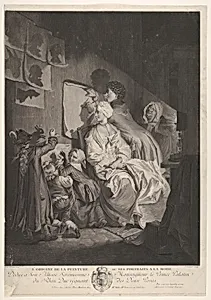
**Origin of Painting** by Johann Eleazar Zeissig, Schenau (17371789), is a captivating 18th-century etching and that explores the mythical beginnings of art. Produced on a generous sheet measuring 19⅛ × 13¼ inches, this print from the Metropolitan Museum of Art's Drawings and Prints department on the ancient legend of Dibut, a Corinthian woman credited with inventing painting by tracing her lover's shadow his departure for war. Schenau, a German Rococo artist known for his delicate reproductive prints, infuses the scene with elegant lines and intricate details, highlighting themes of love, memory, and creativity. Etching and engraving techniques allowed for precise shading and texture, making this medium ideal for disseminating classical myths to a wide audience during the Enlightenment era. The inclusion of women and a coat of arms in the composition—evident from its tags—suggests a blend of personal narrative and heraldic symbolism, perhaps elevating the domestic origin story to a noble artistic lineage. Bequeathed to the Met in 2011 by Phyllis Massar, this work exemplifies how prints bridged ancient lore with 18th-century sensibilities, inspiring viewers to ponder art's timeless roots.
About the Artist
Jean Ouvrier|Johann Eleazar Zeissig, called Schenau (French|French) · 1725 |1714 –1725 |1789
French, 1725–1784|French, Avignon 1714–1789 Paris