
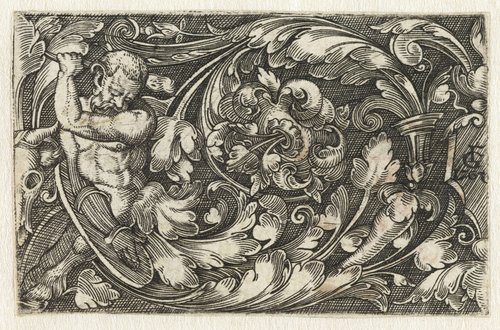
Ornament met centaur
1536
Medium
engraving
Dimensions
66; 42
Rights
Public Domain
About this artwork
height 42 mm x width 66 mm
Art Historical Context
### Ornament met Centaur Step into the whimsical world of Renaissance ornamentation with *Ornament met Centaur (1536), a delicate engraving by the enigmatic Monogrammist. This tiny gem, measuring just 42 mm high by 66 mm wide, captures a mythical centaur—a half-human, half-horse figure classical antiquity—amidst intricate decorative motifs. Attributed to an anonymous artist known only by the initials "FG," likely a Northern European engraver active in the 16th, the work exemplifies the era's fascination with fantastical designs. Engraving, a precise intaglio technique where lines are incised into a metal plate and inked for printing, allowed for the widespread dissemination of ornamental patterns. In 1536, during the Northern Renaissance, such small-scale prints served as pattern books for goldsmiths, architects, and textile designers, bridging art and craft. Monogrammist FG's style reflects the grotesque mode—playful, hybrid forms blending human, animal, and vegetal elements—inspired by Italian precedents like those of Leonardo da Vinci but adapted to Germanic tastes. This piece highlights the Renaissance revival of Greco-Roman mythology, infusing everyday decoration with heroic vigor. Imagine it adorning a jewelry box or bookbinding, its centaur embodying strength and fantasy. A testament to printmaking's revolutionary role, it invites us to appreciate how miniature art shaped broader visual culture.