
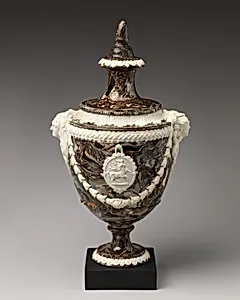
Ornamental agate creamware vase
ca. 1770–80
Medium
Agateware, creamware; basalt
Dimensions
confirmed: 13 11/16 × 7 1/4 × 5 5/8 in. (34.8 × 18.4 × 14.3 cm)
Classification
Ceramics-Pottery
Culture
British
Department
European Sculpture and Decorative Arts
Museum
Metropolitan Museum of Art, New York, NY
Credit
Gift of Tomasso Brothers Fine Art UK, 2018
Accession Number
2018.210.2a, b
Rights
Public Domain
Art Historical Context
In the late 18th century, potteries like Neale & Co., founded by James Neale Hanley, Staffordshire, competed fiercely with innovators such as Josiah Wedgwood. This agate creamware vase created around 1770–80, exemplifies their technical mastery during a golden age of ceramics. Standing at 13 11/16 inches tall, its elegant form showcases the firm's ability to blend luxury and affordability, making high-style objects accessible to a growing middle class. The vase's medium—agateware, creamware, and basalt—highlights innovative techniques. Agateware achieves a striking marbled effect by layering colored clays before firing, mimicking the banded patterns of semi-precious agate stone. Creamware, a refined, cream-colored earthenware developed in the 1760s, provided a smooth, porcelain-like surface without the fragility or cost. Basalt, an unglazed black stoneware, adds a matte, classical depth reminiscent of ancient Greek vases. Together, these create a visually dynamic piece that nods to neoclassical tastes while demonstrating Staffordshire's export-driven prowess. Housed in the Metropolitan Museum of Art's European Sculpture and Decorative Arts department (gift of Tomasso Brothers Fine Art UK, 2018), this vase reflects Britain's ceramic dominance, fueling global trade and influencing designs from teacups to grand ornaments. Visitors can admire how it captures the era's blend of artistry and industry.