
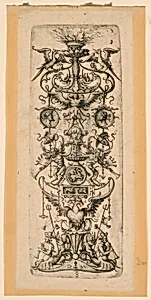
Ornamental Candelabrum
Classification
ornament
Department
Smithsonian Collection
Museum
Smithsonian American Art Museum
Credit
Purchased for the Museum by the Advisory Council
Accession Number
1921-6-25
Rights
Public Domain
About this artwork
Research in Progress
Art Historical Context
Daniel Hopner (1470–1536), a pioneering German artist from Augsburg, created this *Ornamental Candelabrum* around 1520, during the vibrant Northern Renaissance. Known primarily as the first master of etching—a revolutionary intaglio printmaking technique he adapted from armor decoration—Hopner produced intricate ornamental designs that bridged fine art and applied crafts. This piece, classified as an ornament, exemplifies his flair for elaborate motifs inspired by classical antiquity and Gothic traditions, likely intended as a pattern for metalwork, candelabra, or architectural embellishments. Hopner's innovations in etching allowed for fluid, detailed lines that captured the scrolling foliage, fantastical creatures, and symmetrical forms typical of Renaissance decorative arts. His works influenced generations of printmakers and designers across Europe, blending functionality with artistic elegance. Acquired by the Smithsonian American Art Museum through the Advisory Council, this candelabrum reflects the era's fascination with opulent household objects that symbolized status and refined taste. Though research continues, the piece invites us to appreciate Hopner's role in democratizing ornate designs through reproducible prints, making Renaissance splendor accessible beyond elite workshops. A true gem of early modern ingenuity!