
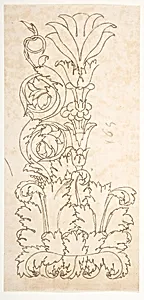
Ornamental drawings (recto) blank (verso)
early to mid-16th century
Medium
Dark brown ink, black chalk, and incised lines
Dimensions
sheet: 10 1/4 x 4 7/8 in. (26.1 x 12.4 cm)
Classification
Drawings|Ornament & Architecture
Department
Drawings and Prints
Museum
Metropolitan Museum of Art, New York, NY
Credit
Purchase, Rogers Fund, Joseph Pulitzer Bequest, and Mark J. Millard Gift, 1968
Accession Number
68.769.62
Rights
Public Domain
Tags
Art Historical Context
This delicate sheet of ornamental drawings, created by an anonymous French artist the early to mid-th century, exemplifies the Renaissance fascination with intricate decorative motifs. Rendered on the recto dark brown ink, black, and incised lines it features floral patterns typical of the period's ornamental designs—likely intended as a pattern sheet for artisans working in architecture, textiles, or metalwork. The verso remains blank, highlighting its practical function over aesthetic display. The use of incised lines is particularly noteworthy: these subtle grooves allowed the design to be transferred onto other surfaces by pouncing with charcoal dust, a common technique in Renaissance workshops. Black chalk provided soft shading and texture to the blooms, while the brown ink offered precise outlines, showcasing the artist's skilled economy on this narrow sheet (10 1/4 x 4 7/8 in.). Such drawings were vital in disseminating decorative styles across Europe, bridging fine art and craft. Housed in the Metropolitan Museum of Art's Drawings and Prints department, this piece offers a window into 16th-century French design culture, where floral ornament symbolized nature's abundance and harmony—enduring motifs that influenced later Baroque and Rococo styles. A testament to anonymous mastery, it invites visitors to appreciate the unsung foundations of artistic splendor.