
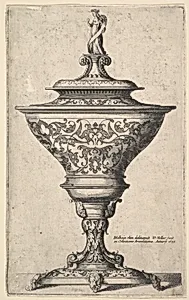
Ornate goblet on feet of masks
Medium
Etching, only state
Dimensions
Plate: 7 1/2 × 4 5/8 in. (19.1 × 11.7 cm) Sheet: 7 5/8 × 4 11/16 in. (19.4 × 11.9 cm)
Classification
Prints|Ornament & Architecture
Department
Drawings and Prints
Museum
Metropolitan Museum of Art, New York, NY
Credit
Rogers Fund, 1917
Accession Number
17.46.3
Rights
Public Domain
Tags
Art Historical Context
This exquisite etching, titled *Ornate Goblet on Feet of Masks*, captures a fantastical Renaissance design attributed to Hans Holbein the Younger (1497–1543) and executed by Wenceslaus Hollar in 1645. Holbein, a master of the Northern Renaissance known for his intricate portraits and ornamental patterns, likely created the original drawing as a model for luxury metalwork. Hollar, a prolific Bohemian etcher active in England, faithfully reproduced it in this sole surviving state—a rarity that underscores its value as a unique print. Measuring just under 8 by 5 inches, the work exemplifies the precision of 17th-century etching, where acid bites into a metal plate to yield delicate, shimmering lines. The composition showcases a lavish goblet elevated on grotesque feet shaped like theatrical masks, possibly evoking female faces, surrounded by scrolling motifs of women and drinking vessels. Such designs drew from Mannerist ornamentation, blending classical grotesques—popularized in 16th-century Italy—with Northern European flair. These prints served practical purposes: goldsmiths and silversmiths used them as blueprints for opulent tableware, reflecting the era's fascination with symbolic, fantastical decor symbolizing revelry or the macabre. Housed in The Metropolitan Museum of Art's Drawings and Prints department (Rogers Fund, 1917), this piece bridges art and craft, highlighting how prints democratized elite designs. Visitors will appreciate its whimsical yet refined detail, a window into the inventive world of Renaissance decorative arts.