
Orpheus and Eurydice
modeled ca. 1887, carved 1893
Medium
Marble
Dimensions
Overall (confirmed): 48 3/4 × 31 1/8 × 25 3/8 in., 856 lb. (123.8 × 79.1 × 64.5 cm, 388.3 kg)
Classification
Sculpture
Culture
French, Paris
Department
European Sculpture and Decorative Arts
Museum
Metropolitan Museum of Art, New York, NY
Credit
Gift of Thomas F. Ryan, 1910
Accession Number
10.63.2
Rights
Public Domain
Tags
Art Historical Context
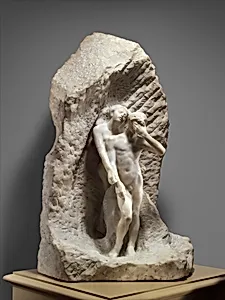
Auguste Rodin's *Orpheus and Euryd*, modeled around 1887 and carved in marble a few years later, captures the Greek myth of the musician Orpheus descending to Hades to retrieve his beloved Eurydice, only to her forever by glancing back. This life-size sculpture (nearly 49 inches tall and weighing over 850 pounds) depicts the tragic lovers in a tender yet tense embrace, their nude forms intertwined in a moment of desperate hope and inevitable doom. Housed in the Metropolitan Museum of Art since a 1910 gift, it exemplifies Rodin's mastery of the human figure from Paris's vibrant late-19th-century art scene. Rodin, a pioneer of modern sculpture, departed from the polished idealism of neoclassicism, favoring rough, textured surfaces that evoke raw emotion and the imperfections of life. The marble's luminous white contrasts with his deliberate chisel marks, suggesting both classical grandeur and fleeting movement—hallmarks of his impressionistic approach. Modeled first in clay, then meticulously carved, the work highlights his innovative process, blending anatomical precision with psychological depth. This piece not only immortalizes a timeless tale of love and loss but also underscores Rodin's influence on 20th-century artists, from Picasso to Henry Moore, by infusing sculpture with narrative drama and sensual vitality. A must-see for visitors exploring the emotional power of European art.
About the Artist
Auguste Rodin · 1840–1917
François Auguste René Rodin (1840-1917) stands as the founder of modern sculpture, transforming the art form from academic tradition into expressive modernism. Born into a working-class Parisian family, Rodin faced early rejection, failing three times to gain admission to the prestigious École des Beaux-Arts. This setback forced him to work as a craftsman for nearly two decades, though his 1875 tr...