
Orpheus and Eurydice
1763–1856
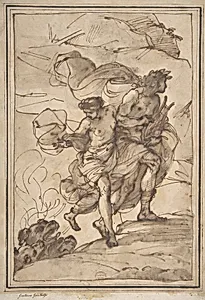
Medium
Pen and brown ink, brush and brown wash, over black chalk
Dimensions
10 15/16 x 7 11/16in. (27.8 x 19.6cm)
Classification
Drawings
Department
Drawings and Prints
Museum
Metropolitan Museum of Art, New York, NY
Credit
Gift of Cephas G. Thompson, 1887
Accession Number
87.12.48
Rights
Public Domain
Tags
Art Historical Context
In the intimate drawing *Orpheus and Euryd* by Italian artist Filippo Pedrini (1763–1856), we encounter a poignant moment from classical mythology. Orpheus, the legendary musician with his lyre, reaches tenderly for his beloved Eurydice, who has lost to the underworld. This scene captures the myth's eternal themes of love, loss, the fragile boundary between life and death—a motif that resonated deeply in European art from antiquity through the Romantic era. Executed in pen and brown ink with brush and brown wash over black chalk, the work exemplifies 18th- and 19th-century draftsmanship techniques. These mixed media allowed Pedrini to achieve subtle tonal gradations and fluid lines, evoking emotion through shadow and gesture on a modest sheet measuring 10 15/16 x 7 11/16 inches. Such drawings often served as studies for larger paintings or standalone treasures, highlighting the artist's skill in narrative storytelling. Acquired as a gift to the Metropolitan Museum of Art in 1887 by Cephas G. Thompson, this piece from the Drawings and Prints department invites us to reflect on how myths endure, bridging ancient tales with Pedrini's era of neoclassical revival. A delicate window into human longing, it reminds visitors of art's power to immortalize fleeting stories.