
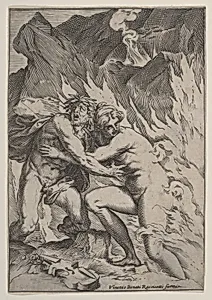
Orpheus and Eurydice
ca. 1590–95
Medium
Engraving, 2nd state
Dimensions
5 1/2 x 4 in. (14 x 10.2 cm) trimmed to the platemark
Classification
Prints
Department
Drawings and Prints
Museum
Metropolitan Museum of Art, New York, NY
Credit
Gift of Henry Walters, 1917
Accession Number
17.37.170
Rights
Public Domain
Tags
Art Historical Context
In the late 16th century,ino Carracci, a engraver and member of the influential Bolognese Carracci family, captured the timeless myth of *Orpheus and Eurydice* in this exquisite engraving, dated around 1590–95. Drawing from classical mythology, the scene likely depicts the tragic moment when Orpheus, the legendary musician, glances back at his beloved Eurydice as they ascend from the underworld, dooming her eternal return. Carracci's composition features dynamic male and female nudes amid flickering fire—evoking the infernal depths of Hades—blending sensual humanism with dramatic tension, hallmarks of the Carracci's shift from Mannerism toward naturalism that paved the way for Baroque art. This second-state impression, trimmed to its platemark at 5½ × 4 inches, showcases Carracci's virtuoso engraving technique: intricate, fluid lines that convey texture, depth, and emotion with remarkable precision. Engravings like this were revolutionary for their time, enabling the widespread dissemination of sophisticated imagery beyond elite patrons, influencing artists across Europe. Printed on a small scale, it invited intimate contemplation, much like a Renaissance cabinet piece. A gift to the Metropolitan Museum of Art from Henry Walters in 1917, this print exemplifies the Carracci's role in revitalizing mythological subjects during the Counter-Reformation, celebrating beauty and narrative while subtly aligning with Catholic ideals of redemption and loss. Visitors will appreciate its technical brilliance and poignant storytelling.
About the Artist
Agostino Carracci · 1557–1602
Agostino left his profession as a tailor to become an artist. His earliest works were engravings, which was an extremely profitable practice and he was famed for having attained new heights of perfection. He was also a skilled painter and collaborated with his famous relations on various commisions. Comment on works: Religious; Portraits.