
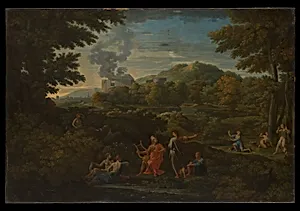
Orpheus and Eurydice
Medium
Oil on canvas
Dimensions
47 1/2 x 70 3/4 in. (120.7 x 179.7 cm)
Classification
Paintings
Department
European Paintings
Museum
Metropolitan Museum of Art, New York, NY
Credit
H. O. Havemeyer Collection, Bequest of Mrs. H. O. Havemeyer, 1929
Accession Number
29.100.20
Rights
Public Domain
Tags
Art Historical Context
Nicolas Poussin's *Orpheus and Eurydice is a captivating oil on canvas from his masterful oeuvre, depicting the poignant myth from Ovid's *Metamorphoses*. The legendary musician Orpheus, lyre in hand, ventures into the underworld to reclaim his beloved Eurydice, only to lose her forever by glancing back—a timeless tale of love, loss, and the human against fate. Rendered in lush forest surroundings, the painting evokes the emotional depth of this classical narrative, drawing visitors into a world where music and nature intertwine with tragedy. As a cornerstone of French Classicism, Poussin (1594–1665) championed balanced compositions, precise anatomy, and moral clarity inspired by antiquity and Raphael. His oil technique allows for luminous landscapes and subtle atmospheric effects, making the expansive 47½ × 70¾-inch canvas a visual symphony of light filtering through trees and expressive figures. This work exemplifies his history painting ideal, blending intellectual rigor with emotional resonance. Housed in the Metropolitan Museum of Art's European Paintings department as part of the prestigious H. O. Havemeyer Collection (bequeathed in 1929), it invites reflection on art's power to immortalize myth. A must-see for those exploring Baroque-era storytelling!
About the Artist
Nicolas Poussin · 1594–1665
Nicolas Poussin, born in June 1594 near Les Andelys in Normandy, emerged from a family of local distinction whose modest means and parental opposition could not deter his artistic calling. He received his initial training under the itinerant painter Quentin Varin in Rouen around 1611–12, absorbing lessons in storytelling, precise facial expressions, and rich colors, though without a formal long-te...