
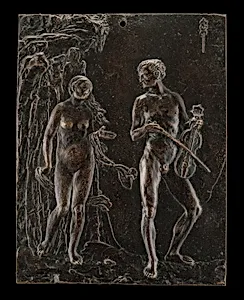
Orpheus and Eurydice
c. 1515
Medium
bronze//Black lacquer (slightly rubbed on raised areas) over medium brown bronze
Dimensions
overall: 19.3 x 14.9 cm (7 5/8 x 5 7/8 in.) gross weight: 1129 gr
Classification
Sculpture
Department
CSD
Museum
National Gallery of Art, Washington, D.C.
Credit
Samuel H. Kress Collection
Accession Number
1957.14.565
Rights
Public Domain
Art Historical Context
This small bronze relief by Peter Vischer the Younger captures the poignant moment from Greek mythology when Orpheus glances back at his beloved Eurydice, dooming her to remain in the underworld. Created around 1515, the work reflects the early sixteenth-century fascination with classical stories, which Northern European artists reinterpreted through a Renaissance lens while retaining intricate, late-Gothic detail. Cast in bronze and finished with a black lacquer patina that highlights the raised surfaces, the sculpture demonstrates the Vischer family workshop’s mastery of metalwork. The compact size—roughly the dimensions of a large book—suggests it was intended for intimate viewing, perhaps as a collector’s piece or decorative panel. The medium’s durability and capacity for fine modeling allowed Vischer to convey both the tenderness and tragedy of the myth within a single, carefully composed scene. Today in the National Gallery of Art’s collection, the relief stands as a testament to the period’s blending of ancient narrative and innovative casting techniques, inviting viewers to appreciate both the story and the craftsmanship that preserved it for centuries.