
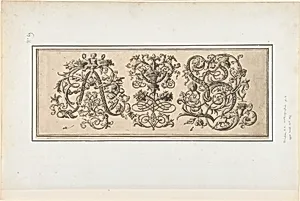
"Orthographia", pl.2
late 17th–mid-18th century
Medium
Etching
Dimensions
5 15/16 x 11 in. (15.1 x 28 cm)
Classification
Prints|Ornament & Architecture
Department
Drawings and Prints
Museum
Metropolitan Museum of Art, New York, NY
Credit
The Elisha Whittelsey Collection, The Elisha Whittelsey Fund, 1948
Accession Number
48.148(69)
Rights
Public Domain
Tags
Art Historical Context
**"Orthographia", Plate 2** by Johann Daniel Preiss invites visitors into the intricate world of 18th-century ornamental design. Created as an etching during the late17th to mid-18th century, this print a compact 5 15/16 x 11 inches and belongs to The Metropolitan Museum of Art's Elisha Whittelsey Collection. Preissler, a prolific engraver from Nuremberg, specialized in detailed reproductive prints that captured the grandeur of Baroque and emerging Rococo aesthetics, making complex motifs accessible to artists and craftsmen across Europe. The title *Orthographia* refers to orthographic projection—a precise drafting technique used to represent three-dimensional forms in two dimensions, ideal for architectural and decorative plans. As plate 2 from a series on ornament and architecture, it likely showcases elegant motifs such as scrolls, foliage, or cartouches, rendered with fine lines that embody the period's fascination with symmetry and embellishment. Etching, Preissler's chosen medium, allowed for fluid, expressive lines etched into a metal plate with acid, producing crisp reproductions that served as invaluable pattern books for goldsmiths, woodcarvers, and builders. These prints hold cultural significance as bridges between art and design, democratizing opulent styles during an era of expanding trade and grand palaces. Acquired through The Elisha Whittelsey Fund in 1948, this work exemplifies how such technical marvels fueled the decorative arts revolution. Pause here to appreciate the meticulous craft that once inspired Europe's lavish interiors!