
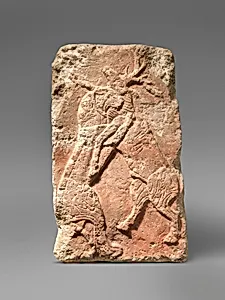
Orthostat relief: lion attacking a deer
Unknown Artist
ca. 10th−9th century BCE
Medium
Limestone, paint
Dimensions
28 3/8 × 17 1/2 × 8 7/16 in., 426 lb. (72 × 44.5 × 21.5 cm)
Classification
Stone-Reliefs-Inscribed
Culture & Period
Hittite · Neo-Hittite
Department
Ancient Near Eastern Art
Museum
Metropolitan Museum of Art, New York, NY
Credit
Rogers Fund, 1943
Accession Number
43.135.3
Rights
Public Domain
Tags
Art Historical Context
This striking orthostat relief, carved from limestone and originally painted, captures a dramatic moment: a powerful lion lunging at a deer in mid-struggle. Dating to the 10th–9th BCE, it hails from the Neo-Hite culture, a period when successor states to the mighty Hittite Empire flourished in Anatolia and northern Syria. These massive stone slabs—measuring nearly 28 by 17 inches and weighing over 400 pounds—formed the lower walls of palaces and temples, serving both structural and decorative purposes. In Neo-Hittite art, such predator-prey scenes symbolized raw power, royal might, and the natural order, often evoking the king's dominion over chaos or divine protection for the city. The low-relief carving masterfully conveys motion through tensed muscles, flowing manes, and dynamic poses, with traces of ancient paint hinting at vibrant colors that once heightened the scene's intensity. Though the artist remains unknown, this work exemplifies the sophisticated stoneworking techniques of the era, blending Hittite traditions with emerging influences from neighboring regions. Displayed in the Metropolitan Museum of Art's Ancient Near Eastern Art department, this relief transports visitors to a world of monumental architecture and mythic symbolism, reminding us of the enduring fascination with nature's fierce ballet.