
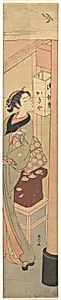
Osen of the Kagiya Teahouse
ca. 1769
Medium
Woodblock print; pillar print (hashira-e); ink and color on paper
Dimensions
H. 25 7/8 in. (65.7 cm); W. 4 7/8 in. (12.4 cm)
Classification
Prints
Culture & Period
Japan · Edo period (1615–1868)
Department
Asian Art
Museum
Metropolitan Museum of Art, New York, NY
Credit
Rogers Fund, 1922
Accession Number
JP1276
Rights
Public Domain
Tags
Art Historical Context
Suzuki Harunobu's *Osen of the Kagiyaahouse* (ca. 1769) is a captivating woodblock pillar print (*hashira-e*), a tall, narrow format designed to hang gracefully on the wooden pillars of Edo-period homes. Measuring nearly 26 inches high but just under 5 inches wide, ink and color on paper print exemplifies the ukiyo tradition—"pictures of the floating world"—celebrating fleeting pleasures like beauty and urban life. Harunobu, a pioneering master of full-color (*nishiki-e*) prints revolutionized Japanese printmaking in the 1760s by introducing vibrant multi-color techniques, bringing unprecedented realism and delicacy to his depictions of women. The subject, Osen, was a real-life beauty who worked at the famed Kagiya teahouse in Edo (modern Tokyo), a hub for intellectuals and artists during the Edo period (1615–1868). Often shown with her signature long pipe (*kiseru*), Osen embodied the era's fascination with *bijin-ga* (beautiful women), blending elegance and everyday allure. Harunobu's subtle gradations of color and fine lines capture her poised grace, evoking the teahouse's intimate, smoky atmosphere. This print not only highlights Harunobu's technical innovation but also offers a window into 18th-century Japanese social culture, where teahouses served as vibrant social spaces amid the rigid Tokugawa regime. A Rogers Fund acquisition now at the Metropolitan Museum of Art, it invites visitors to appreciate the artistry that made ukiyo-e a global sensation.
About the Artist
Suzuki Harunobu · 1725–1770
Suzuki Harunobu (c. 1725-1770) was a Japanese ukiyo-e artist who revolutionized woodblock printing by developing nishiki-e—full-color prints using multiple woodblocks—in 1765. Before Harunobu, Japanese prints were limited to two or three colors; his innovation unleashed the entire artist's palette, transforming ukiyo-e into the vibrant art form that would later captivate Western artists from Manet...