
Osome and Hisamatsu
c. 1720
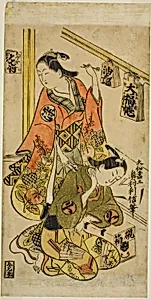
Medium
Hand-colored woodblock print; hosoban, beni-e
Dimensions
28 × 15.6 cm (12 3/8 × 6 1/8 in.)
Classification
woodblock print
Department
Arts of Asia
Museum
Art Institute of Chicago
Accession Number
19671
Rights
Public Domain
Art Historical Context
Step into the vibrant world of early 18th-century Japan with *Osome and Hisamatsu*, a captivating hand-colored woodblock print by Okumura Toshin, created around 1720. This intimate scene likely captures a poignant moment from the tragic love story of the titular lovers, drawn from popular joruri puppet theater by Chikamatsu Monzaemon—a of forbidden romance and heartbreak that enthralled Edo audiences. Toshinobu, an innovative ukiyo-e artist, specialized in yakusha-e (actor portraits) and bijin-ga (images of beauties), blending sharp lines with delicate hues to evoke the "floating world" of theater and fleeting pleasures. Printed in the narrow hosoban format (28 × 15.6 cm), this beni-e—meaning "rose-colored picture"—showcases an early technique where subtle reds and other colors were hand-applied to black-and-white blocks. Before the multicolored nishiki-e prints of later masters like Hiroshige, beni-e like this one marked a playful evolution in ukiyo-e, making art affordable and accessible to urban merchants and theatergoers. Housed in the Art Institute of Chicago's Arts of Asia collection, *Osome and Hisamatsu* reflects Japan's cultural obsession with kabuki and joruri during the Genroku era's golden age of popular entertainment. It's a window into how woodblock prints democratized storytelling, turning dramatic narratives into cherished keepsakes.
About the Artist
Okumura Toshinobu · 1690–1770
active ca. 1717–1750