
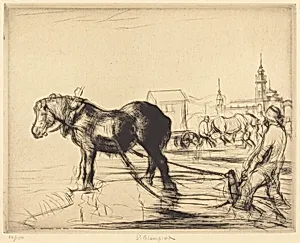
Ostend Horse
1926
Medium
drypoint on laid paper
Dimensions
plate: 17.9 × 22.7 cm (7 1/16 × 8 15/16 in.) sheet: 23.7 × 32.3 cm (9 5/16 × 12 11/16 in.)
Classification
Department
CG-W
Museum
National Gallery of Art, Washington, D.C.
Credit
Gift of Mrs. Fred Rieth
Accession Number
1968.10.2
Rights
Public Domain
Art Historical Context
In the fishing communities around Ostend, horses were once used to drag heavy nets through shallow seawater pools at low tide, allowing men to gather shrimp that would otherwise escape in deeper water. Edmund Blampied recorded this practice in 1926 while working along the Belgian coast, where such methods still persisted amid changing times. The drypoint conveys the labor through the horse’s lowered head and braced legs, set against the lighter, quicker strokes that describe the water and the distant figures. The man’s bent posture and grip on the net suggest steady direction rather than brute strength, a balance that keeps the scene from becoming mere spectacle. Blampied made the print as a drypoint on laid paper, and it belongs to the National Gallery of Art in Washington. Look at the single taut line of rope where it enters the water just ahead of the horse’s front hooves, as the pressure there shows how the animal’s weight meets the hidden resistance of the net.